Turning Nature Risk Data into Board-Level Decisions
- Nature Tech
- Climate
- TNFD
- Product Design
This project was a half-day experiment with AI — learning how to work with LLMs to clarify design briefs, break down problems, and rapidly prototype UI and UX.
Company
Terraverde (concept)
Challenge
How do you turn rigorous nature risk data into recorded, attributed board-level decisions?
Team
- Solo designer (me)
Skills / My role
- Product design
- UX research
- Visual design
- Interactive prototyping
- AI-assisted build
The people who understand nature risk and the people who must act on it speak different languages
Nature-related financial risk is becoming a board-level concern. Regulations like TNFD and CSRD now require companies to demonstrate governance over it. The evidence that ecological degradation creates material business exposure keeps growing.
But there's a gap that hasn't yet been properly addressed. The Sustainability Manager has done rigorous analysis: they understand how pollinator decline becomes a supply chain cost, how water scarcity becomes a revenue risk. And then they put it all into a slide deck and walk into a boardroom full of people who think in revenue, margin, and shareholder value.
The board listens, asks a few questions, and says “we'll look into it.” No recorded decisions. No governance trail. Time to do something about it.
Terraverde is a solution to fix this – turning nature risk data into recorded, attributed board-level decisions.
Talking to sustainability managers, competitor analysis, and TNFD documentation
I started by talking to people. A few friends work as Sustainability Managers at companies with large, complex supply chains. I asked them what happens when they present nature risk to their boards. Their answer: the data is there, the analysis is rigorous, and the board nods politely and moves on. One described it as “performing concern.” The board performs concern, the Sustainability Manager performs optimism, and nothing changes.
I spent time with the TNFD documentation. The framework outlines what governance looks like: recorded decisions, attributed to individuals, with evidence of oversight. Most companies aren't close to this. The tools don't exist to make it easy.
I looked at what's out there. Competitor analysis turned up sustainability dashboards, ESG reporting platforms, and risk visualisation tools. Most of them are designed for the Sustainability Manager. Almost none are designed for the moment that actually matters: the board meeting where someone has to decide.
Two users who need very different things
The Sustainability Manager has completed a risk assessment. They know the science, the causal chains, the frameworks. What they struggle with is translation. How do you make ecological complexity land with a financially-minded audience without losing the rigour? They also feel emotionally exposed too. If this presentation goes well, they become a strategic advisor. If it doesn't, they stay the person the board tolerates for 15 minutes before moving to the real agenda.
The Board is time-poor, sceptical by design, accountable to shareholders and regulators. They're increasingly aware they should understand nature risk. Research shows only 2% of company boards have demonstrated biodiversity expertise. They don't want to feel ignorant. They don't want to feel lectured. They want to feel in control of whatever decision they're being asked to make.
The medium needs to feel familiar to board directors—for ease of understanding and trustworthiness
Directors spend their week in board packs, risk committees, and financial updates. When nature risk material looks and reads like that kind of content, they can parse it quickly and treat it as part of the same serious conversation. Too often, Sustainability Managers show up with decks that look like environmental reports—green colour schemes, sustainability imagery, ecological terminology. The content might be about £45M of revenue at risk, but the visual language says “here's an update from the sustainability team.” The board mentally files it in the same category as the recycling policy.
Boards don't have a way to decide
Board meetings about nature risk produce discussion. They do not produce decisions. There's no structured mechanism for a board member to say “we approve mitigation on this risk” or “we consciously accept this one.” Under TNFD, companies need recorded, timestamped, attributed decisions. Not “we discussed it.” But nobody has given boards a tool that makes deciding easy.
The Sustainability Manager and the board need opposite things from the same data
The Sustainability Manager needs a workspace. Dense information, editing controls, the ability to curate. The board needs a presentation. Clean, progressive, focused on getting to a decision. These two needs are fundamentally incompatible in a single interface. Every existing tool I looked at tried to serve both and compromised on each.
Briefing pack vs presentation format
I tried this briefing pack direction first. It felt right for the Sustainability Manager. They could craft it carefully, control the narrative. But when I thought about the board experience, it felt unengaging. There's no progressive disclosure guiding you from headline to detail to action.
So I moved to a presentation format. Something more like an interactive briefing that leads the board through layers of information and asks them to decide at the end. This meant sacrificing some of the depth the Sustainability Manager might want. But it meant the board experience was active rather than passive. Every screen moves toward a decision.
Three solutions
Each insight pointed at a specific design failure. Each solution addresses it directly.
Design it like an analyst briefing, not an environmental report
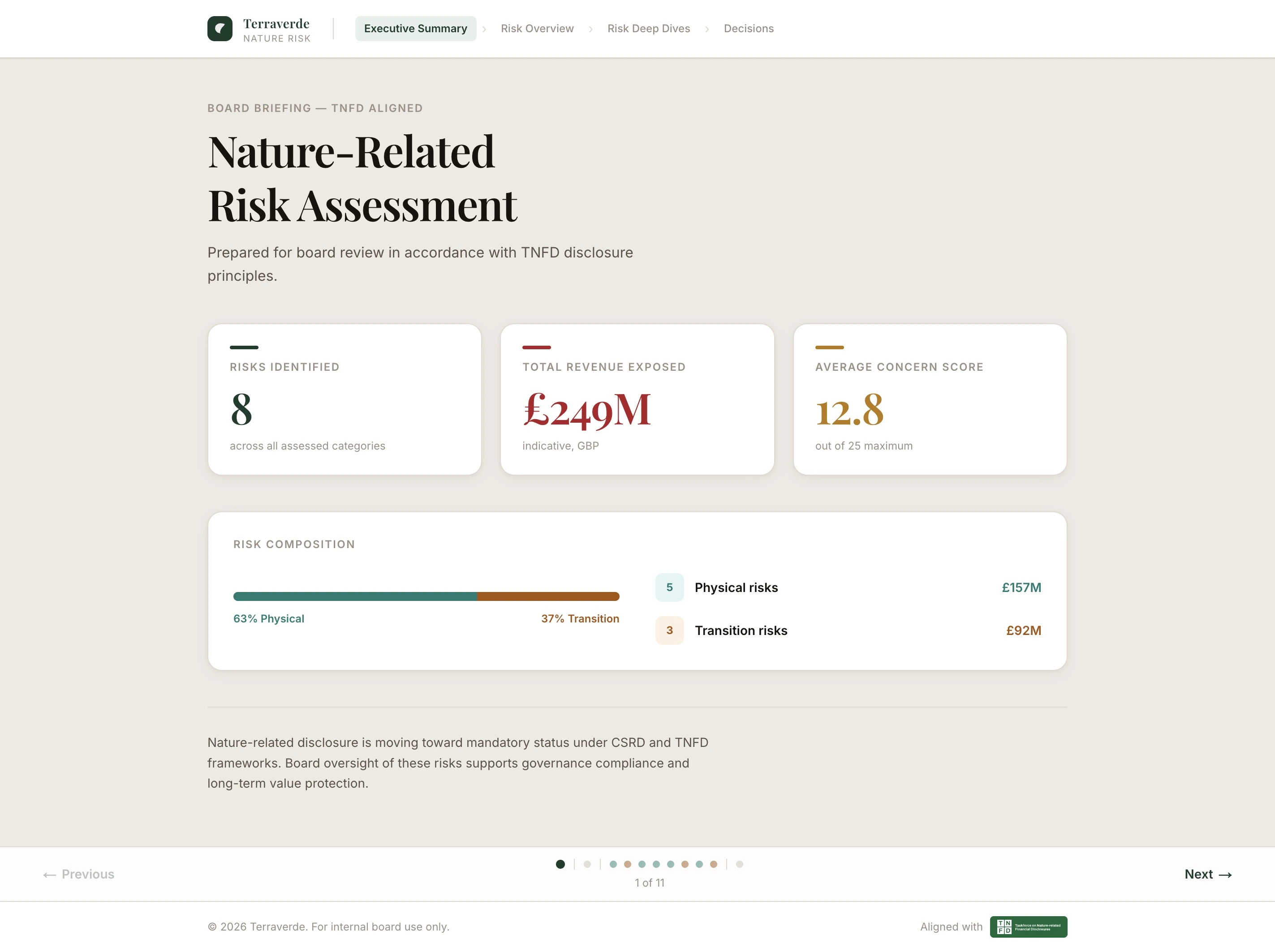
The visual identity uses warm, muted tones on a linen-textured background. Serif headings for authority. Generous whitespace. The whole thing references financial analyst reports and premium consultancy documents.
Headings use financial framing. Instead of “ecological impact on barley supply” we talk about “Revenue Exposed: £45M.” Not “recommended conservation programme” but “Indicative Investment: £2M–£4M over 3 years.”
Because perception is set in the first five seconds. If the board's subconscious reaction is “environmental report,” everything that follows fights uphill. If their reaction is “financial risk briefing,” the Sustainability Manager starts from a position of authority. Same data but careful positioning.
A three-option decision framework with governance trail
I gave the board exactly three options per risk: Commit (proceed with mitigation planning), Investigate (need more information), or Tolerate (acknowledge risk, no action now). Those terms took serious consideration for clarity.
The detail that took the most thought was “Tolerate.” Conscious risk acceptance is a legitimate governance decision. It's not negligence. But if the interface treats it as negative — red colour, warning language — boards won't use it honestly. So I gave Tolerate a neutral visual treatment, muted grey. Avoiding the negative connotation.
Once decided, a confirmation screen shows the aggregate consequence: total approvals, flags, acceptances, investment committed, revenue addressed. Then it locks. Timestamped, attributed, read-only. That confirmation screen is an important moment in the entire product, where passive listening becomes active governance.
Two different modes
I separated the experience into Prepare (the Sustainability Manager working alone) and Present (the board-facing artefact), connected by a publish action.
In Prepare mode, the Sustainability Manager selects which risks to include, reorders them for narrative impact, and enriches each one with company-specific context. “What happens if we do nothing?” and “Proposed Response” are required fields. This forces every risk to arrive at the board with both the problem and a credible path forward.
In Present mode, the board gets progressive disclosure across four layers. The Executive Summary answers “how big is this?” in 30 seconds. The Risk Overview shows ranked cards (not a scatter plot — I can't assume data literacy at board level). The Risk Deep Dive shows the full causal chain: Source of Risk → Transmission Channel → Financial Risk. And Decision Capture is where the three-option framework lives.
Where AI could take each solution
Financial reframing. The hardest part of the analyst briefing approach is translating ecological language to financial language. An AI layer could take raw assessment data and generate first-draft financial framings automatically. “Pollinator decline affecting barley yield in East Anglia” becomes “Revenue Exposed: £45M across 3 product lines dependent on barley supply.” The Sustainability Manager reviews and edits, but the AI does the heavy lift.
Decision intelligence. Once boards have used the tool across multiple quarters, the AI could surface patterns. “You flagged water scarcity risk last quarter and it has since escalated from medium to high concern. Three peer companies have begun mitigation.” Over time, the AI builds institutional memory around nature risk governance.
Prepare mode enrichment. AI could generate draft enrichment content: pulling recent news, surfacing competitor actions, suggesting inaction consequences. The Sustainability Manager curates rather than creates from scratch. The key constraint is that AI-generated content must be clearly labelled and editable. The Sustainability Manager is the author. The AI is the research assistant.
What lives beyond the boundaries
Terraverde is one piece of a larger system. I scoped the briefing tool tightly, but a staff designer should think about what's on the other side of those boundaries.
Upstream, the assessment platform produces the risk data, concern scores, and causal chains. The causal chain visualisation (Source → Transmission → Financial) requires the assessment to produce data in that structure. This means the briefing design needs to inform the assessment data model, not just consume it.
Downstream, locked decisions need to trigger action. A “Commit” decision should feed into mitigation planning. A “Invesigate” should generate an investigation brief. A “Tolerate” should be logged in the TNFD disclosure evidence base. The data structure I designed for decision capture — timestamped, attributed, with portfolio-level summaries — was built with these downstream consumers in mind.
Laterally, the governance trail has value beyond the board meeting. Investor relations need it for TNFD disclosures. Legal need it for liability documentation. The Sustainability Manager needs it for regulatory reporting.
How I used AI to build this
I used AI throughout the project. In the research phase, I used Claude to investigate the problem space deeply — exploring TNFD requirements, mapping the landscape of nature risk communication tools, stress-testing the job stories against edge cases, and interrogating my assumptions about board behaviour.
For the build, I used Claude Code to go from design concept to working prototype in about 4 hours. The speed meant I could test whether the progressive disclosure actually felt right as an interactive experience rather than just a wireframe. It meant I could try the briefing pack approach, feel that it was wrong, and pivot to the presentation format without losing a week.
AI didn't replace the thinking. The conversations with Sustainability Managers, the insight about the medium undermining the message, the decision to make “Accept” feel neutral — those came from research and judgement. But AI collapsed the distance between having a design conviction and being able to test it.
Explore the working prototype
I built a working prototype to test the core interactions — the progressive disclosure, the decision capture flow, and the visual language that positions nature risk as a financial concern. You can explore it yourself to see how the Prepare and Present modes work together.
Defining the boundaries of this problem space
It's not a risk assessment tool as the assessment happens upstream. It's not project management because mitigation directions are categories of response, not plans with milestones. It's not a TNFD report generator though it creates the governance evidence TNFD requires.
The focus is on moving the board toward an informed decision. I cut anything that didn't serve that.
Designing for nature risk governance?
Whether you're building sustainability platforms, climate tech tools, or anything where complex data needs to reach decision-makers — I can help you design the experience that gets people to act.
Get in touch